

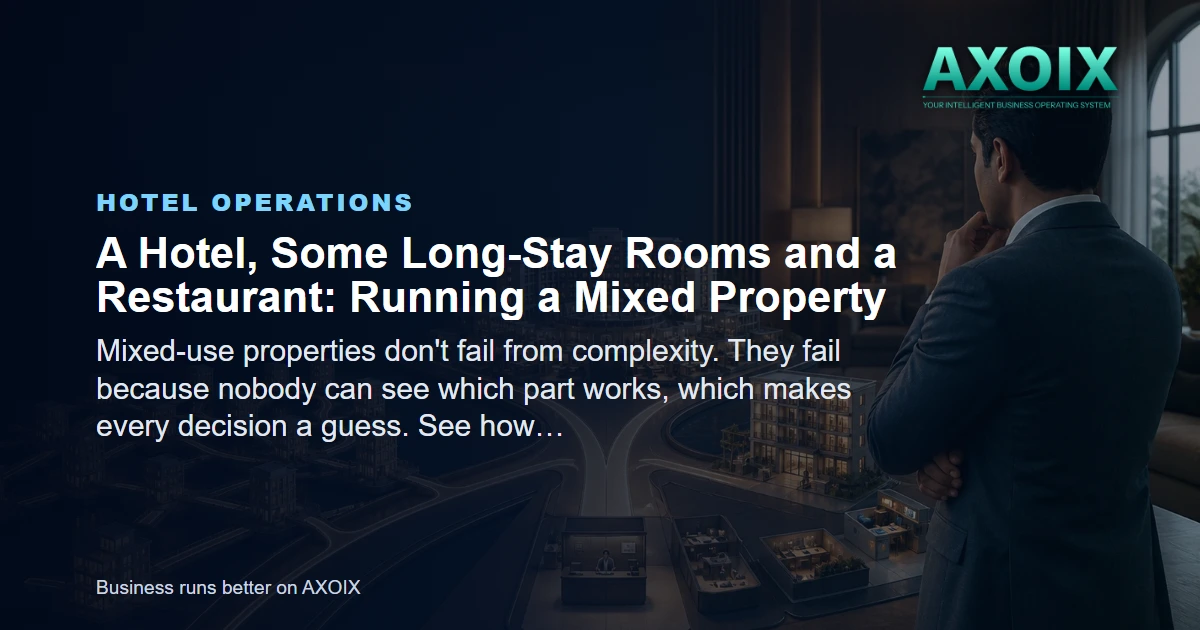
A very common Indian property shape: twenty rooms sold nightly, eight rooms let monthly to long-stay tenants, and a restaurant on the ground floor open to the street. One building, one owner, one staff roster — and, almost always, three separate systems that don't know about each other.
Quick answer (for the impatient)
These are genuinely different businesses — different billing cycles, different guests, different compliance.
They share the things that matter: the building, the staff, the books and the owner's attention.
Separate systems make the shared parts unmeasurable, which is where owners lose money without seeing it.
Why one system for everything is wrong too
Worth saying before the obvious pitch: forcing a monthly tenant through nightly-stay software is as bad as separate systems. A long-stay resident isn't a guest who stayed thirty nights. They have a rent cycle, a security deposit, a notice period, possibly utilities apportioned by meter, and none of that fits a folio.
The right model is different operations that share a foundation — one company, one set of books, one staff roster, one owner view — with each operation running on logic that suits it.
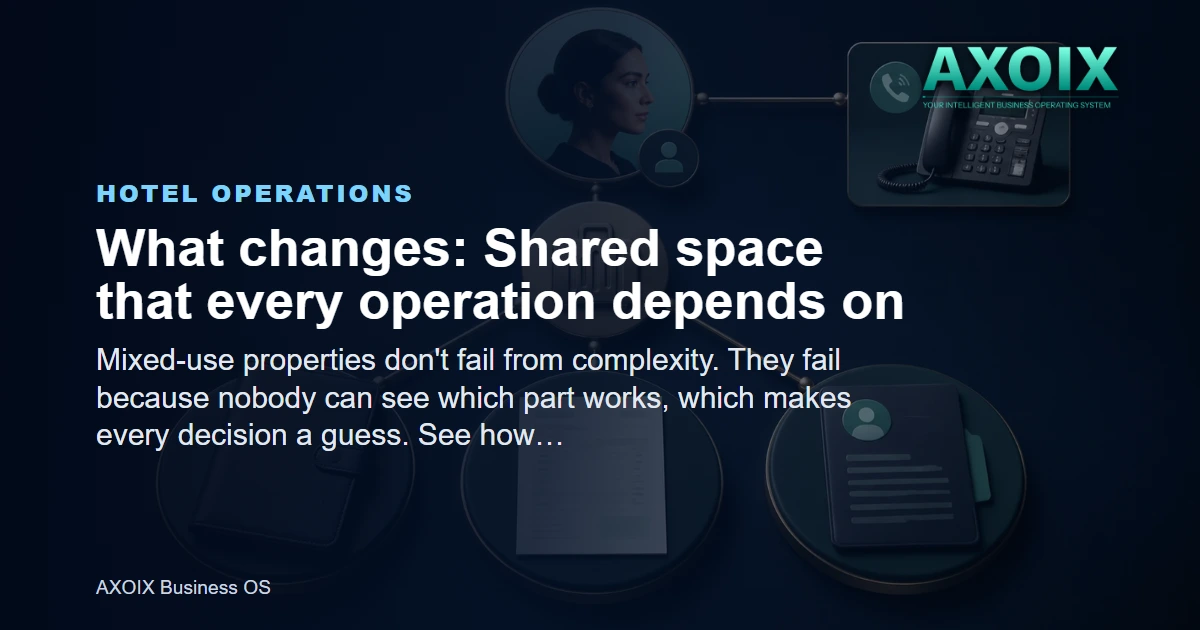
What actually goes wrong with three systems
Nobody knows which part is profitable. The restaurant looks busy, the rooms look full, and if the building isn't making money the owner can't tell which operation is carrying which. See what to measure.
Shared costs get allocated by guesswork. Electricity, water, security, the manager's salary, the building loan — split by feel, if at all.
Staff time is invisible. The same person covers reception and supervises the restaurant, and neither system knows.
The books are assembled from three exports, monthly, by hand. See why that gap costs more than the time.
Inventory and F&B leak. A restaurant that also serves room service and staff meals has three consumption paths and usually tracks one.
The allocation question is the real one
Most mixed-property owners have never allocated shared costs deliberately, which means every profitability question is unanswerable. Worth deciding explicitly:
Space — allocate building costs by area occupied. Simple, defensible, and usually reveals that the restaurant's ground-floor footprint is expensive.
Utilities — sub-meter where you can. A commercial kitchen's consumption is not comparable to guest rooms, and averaging hides it entirely.
Shared staff — allocate by rough time split, reviewed occasionally. Precision isn't the point; having any basis is.
The owner's own time — worth noting even if not charged, because it frequently reveals that the smallest operation consumes the most attention.
Do this once and the strategic question — which operation to grow, shrink or exit — becomes answerable for the first time.
Where the mix genuinely helps
The combination isn't just complexity. Long-stay tenants provide baseline occupancy and predictable cash through the off-season, which is exactly when nightly rooms are weakest. A restaurant serves both operations and the street, spreading its fixed costs across three demand sources.
Run deliberately, mixed use is a hedge. Run accidentally, it's three half-managed businesses competing for one manager's attention.
The compliance overlay
Each operation brings its own obligations, and they don't merge. Nightly rooms carry guest register and Form C duties. Long-stay tenancies raise rent agreement and tenant verification questions. The restaurant needs FSSAI in its own right, and the GST treatment differs across all three.
This is the most under-appreciated part of mixed use, and the one most likely to produce an unpleasant surprise. Confirm each with a professional rather than assuming the hotel's approvals cover the building.
A realistic hotel example: what the team sees during a working shift
Picture Lakeview Residency, an independent property where the same manager may answer a booking query, approve a rate, settle a guest account and help a new employee before lunch. The question behind A Hotel, Some Long-Stay Rooms and a Restaurant: Running a Mixed Property does not arrive as a neat software task. It arrives while somebody is waiting, another department needs an answer and the record must still make sense at the end of the day.
The first useful observation is this: These are genuinely different businesses — different billing cycles, different guests, different compliance. The manager should translate that statement into a visible hand-off. Who starts the action? Which record do they open? What information must already be present? Who checks the result? If any answer depends on one experienced employee remembering an exception, the process is not yet reliable.
The second observation is equally practical: They share the things that matter : the building, the staff, the books and the owner's attention. At Lakeview Residency, the team would test this with one ordinary case and one awkward case. The ordinary case confirms the expected path. The awkward case exposes missing permissions, incomplete data, unclear ownership or a decision that still happens in a private message. Both tests matter because hotel operations rarely fail on the clean example shown in a demonstration.
The third observation is about the downstream record: Separate systems make the shared parts unmeasurable , which is where owners lose money without seeing it. A completed action should leave enough context for the next person to understand what happened without reconstructing the story from calls and chat messages. That does not mean collecting every possible field. It means keeping the few facts that change the decision, the status, the responsible role and the next action together.
Rollout checklist: move from a good idea to a repeatable process
Use this checklist before the team treats the workflow as normal operating procedure. It deliberately separates product reachability from management discipline: software can make a record available, but the property still decides who owns it and how exceptions are handled.
Name the owner. Choose the role responsible for starting and completing the process. "The office" or "the front desk" is too vague when several people share a shift.
Confirm access. Test with the real role and tenant configuration, not an unrestricted demonstration account. Check enabled modules, feature permissions and the property or outlet context.
Define the minimum input. Agree which guest, room, date, amount, document or operational detail must be present before somebody can act.
Run the normal case. Complete one realistic example from beginning to end and ask the next team member to explain the result using only the saved record.
Run the exception. Try a correction, cancellation, missing value, late change or disputed instruction that genuinely occurs at the property. Record the fallback if the product path does not cover it.
Check the hand-off. Make sure the relevant people in front desk, reservations, housekeeping and accounts can see the status they need without receiving unnecessary access to unrelated records.
Write the fallback. If the system is unavailable or the case sits outside the verified path, state who records the temporary decision and who reconciles it later.
Review after live use. Ask staff where they paused, duplicated work or returned to a spreadsheet. Fix the process before adding more fields or automation.
Decision table: evidence to collect before you approve the workflow
A manager does not need a large transformation project to evaluate this topic. A short evidence review is enough to distinguish a reachable workflow from an attractive claim. Use the table during a property review and write the answer in plain language.
Review point What to verify Evidence to keep Decision if it fails
Reachability The responsible role can open and complete the path in the correct tenant and property context. A completed test record and the role used. Do not announce the workflow; check provisioning and permissions.
Data quality The minimum information needed for the decision is present, understandable and current. The input checklist and one reviewed example. Fix the collection step before adding automation.
Ownership One role owns the next action and another can review where separation is appropriate. The operating owner and escalation path. Assign responsibility before rollout.
Exception handling A correction, cancellation or disputed case has a documented path. The tested exception and fallback note. Keep the process in controlled trial use.
Downstream hand-off The next department sees the status it needs without manual re-entry or excessive access. A hand-off check by the receiving role. Use a documented interim hand-off and reconcile it.
The honest AXOIX limit and what to review after the first live cycle
The first review should focus on behaviour, not vanity metrics. Ask the people who performed the work where they hesitated, what they entered twice and which decision still escaped into a phone call or personal message. Compare the saved record with what actually happened. If they differ, find the earliest point where context was lost.
Then separate a training problem from a product boundary. A training problem means the verified path exists but the team did not understand the trigger, required input or next action. A configuration problem means the module, property context or permission is not available to that role. A product boundary means the audited path does not support the case. Those three diagnoses require different responses; calling all of them "user error" guarantees a repeat.
Keep the limitation visible while reviewing this article: Verify the workflow and its applicability before relying on it. That boundary is part of the buying and rollout decision, not a footnote to remove from the sales conversation. Where the workflow is usable, test it honestly. Where it is partial, keep the manual control explicit. Where applicability depends on law, policy or professional judgement, confirm it with the appropriate adviser.
FAQ
Can the same rooms be used for both nightly and monthly?
Commercially yes, and many owners flex this seasonally. Just be clear which basis a given room is on at a given time, since the billing and compliance differ.
Should the restaurant be a separate legal entity?
A question for your CA — the answer turns on turnover, GST position and liability, not on convenience.
How do I know which operation to grow?
Allocate shared costs properly first. Almost every mixed-property owner who does this is surprised by the answer.
How should a hotel test this before rolling it out?
Use the real tenant, property context and staff role. Complete one ordinary case and one exception from start to finish, then ask the receiving role to verify the saved result without relying on a private message.
What should the team do if the verified product path does not cover its case?
Keep a documented manual control, name the person responsible for reconciliation and avoid describing the unsupported step as automated. Recheck module provisioning and permissions before concluding that a capability is absent.
The bottom line
Mixed-use properties don't fail from complexity. They fail because nobody can see which part works, which makes every decision a guess.
See how hotel, PG and F&B on one system works, how owner reporting handles it, or pricing.
One building, one clear picture. Start free →

Comments