

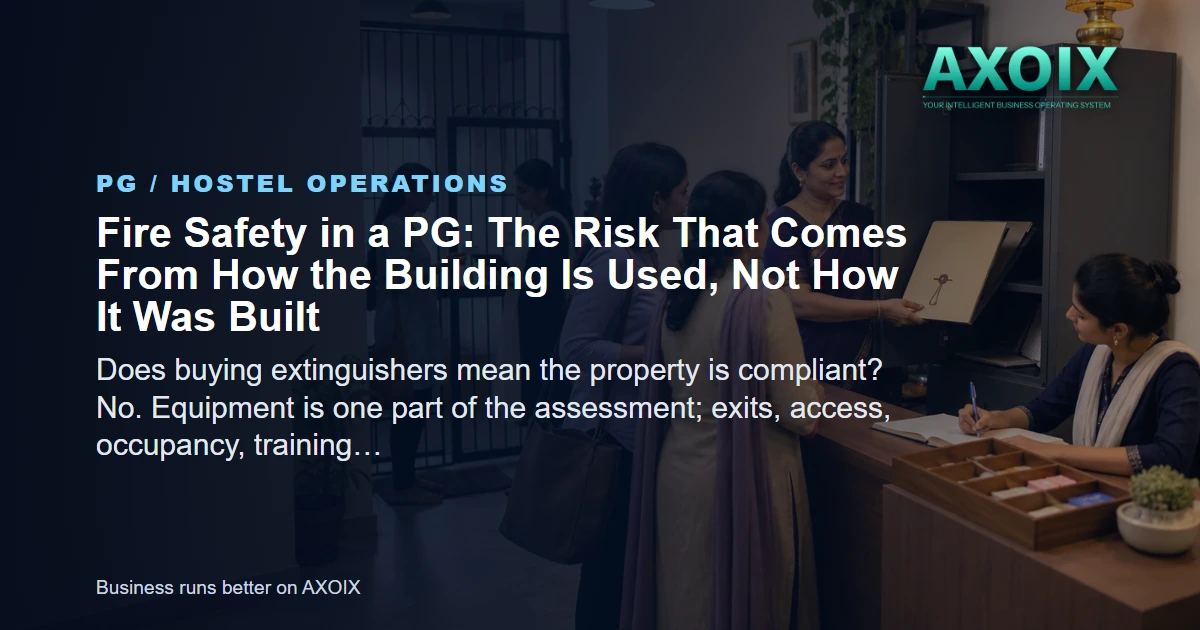
Most PGs operate from buildings designed as homes. A three-bedroom flat built for a family of five, now housing fourteen people who don't know each other, is a different fire risk from the one the building was approved for — and nothing about the building changed.
Quick answer (for the impatient)
The risk comes from occupancy, not construction. More people, unfamiliar with the building, often asleep.
Requirements are state-specific and scale with building height and occupancy.
The most common real hazard is a blocked escape route, and it's usually created by the PG's own storage.
Why PG occupancy changes the risk
Three factors compound in a way that's easy to miss:
Density. More people per square metre than the layout anticipated, which means more time to evacuate through the same exits.
Unfamiliarity. A family knows its home in the dark. A resident who moved in last week does not, and smoke removes visibility entirely.
Ignition sources. A commercial-scale kitchen, multiple heating appliances, extension boards running several devices per room, and phone chargers left overnight in every bed.
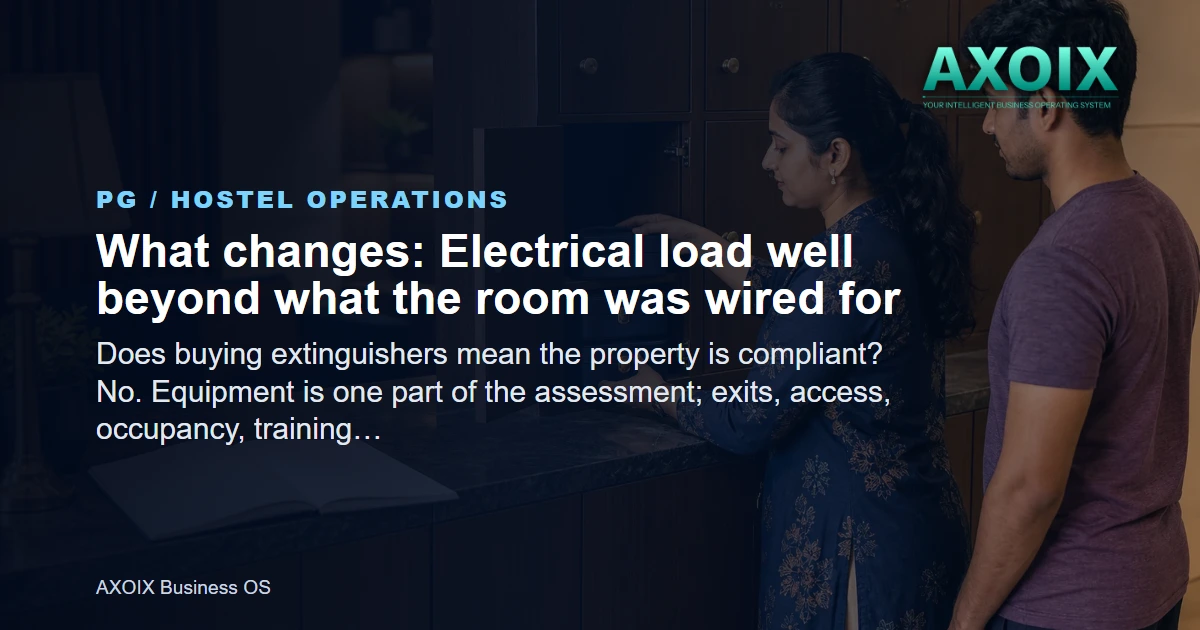
The electrical point deserves emphasis. A room built with two power points now serving four residents with laptops, chargers, fans and heaters is running through extension boards that were never intended for sustained load. This is the most common cause of fire in dense residential occupancy and the cheapest to address.
The escape route problem is self-inflicted
Almost every PG has an escape route problem, and almost every one created it themselves. The recurring versions:
Stairwells and landings used for storage — luggage, mattresses, cleaning supplies, old furniture.
A corridor narrowed by adding a cupboard or an extra bed.
The rear exit locked at night for security, with the key in someone's room.
A terrace exit padlocked to stop residents going up there.
Grilles on windows with no openable section.
Each of those decisions was reasonable in isolation and was made for a real reason, usually security. Together they mean the building has one usable exit in an emergency at night.
The locked-exit case is worth thinking about carefully: the security concern is genuine, and the answer is a solution that opens from inside without a key rather than accepting the trade. That's a solvable problem and it's the single highest-value fire safety change most PGs can make.
What to have, regardless of what's required
Working smoke detection, particularly on escape routes and near the kitchen. Cheap, and the single thing most likely to prevent deaths at night.
Serviced extinguishers, of the right type — including one appropriate for a kitchen, which is not the same as the general one.
Clear, permanently unobstructed escape routes. Check weekly; storage reappears.
Exits openable from inside without a key, always.
Emergency lighting on stairs and corridors.
Electrical load assessed against actual usage, not original design.
Residents told what to do — where to go, at induction, not by a notice nobody reads.
That last one costs nothing and is skipped almost universally. Two minutes at move-in, showing a new resident the exit route, is more valuable than most of the equipment.
A practical operating workflow for this PG
The useful way to apply Fire Safety in a PG: The Risk That Comes From How the Building Is Used, Not How It Was Built is to turn the idea into a repeatable operating rhythm. Start with the current process, not the software screen. Write down who begins the task, what information they need, where the record is kept, who checks an exception, and what the resident is told. That prevents a common PG mistake: digitising an unclear process and discovering that the same argument now happens faster.
Step 1 — establish the starting record. The risk comes from occupancy, not construction. More people, unfamiliar with the building, often asleep. The owner or warden should decide which field, document or confirmation is the source of truth. Existing residents, rooms, balances or requests should be checked before a new workflow is switched on. If the starting record is incomplete, note the gap openly instead of filling it with an assumption.
Step 2 — define responsibility. Requirements are state-specific and scale with building height and occupancy. Name the person who enters the record, the person who can approve a change, and the person who follows up when something is overdue. In a small PG those roles may belong to one person, but writing them down still matters. It stops a cook, caretaker, accountant and owner from each believing that somebody else handled the same exception.
Step 3 — test one real case end to end. The most common real hazard is a blocked escape route , and it's usually created by the PG's own storage. Use one room, one resident or one billing cycle first. Follow the record from the first action to the final acknowledgement. Check the owner view, staff view and resident-facing result separately. A backend record or internal screen is not enough if the person expected to act cannot reach it.
Step 4 — keep an exception path. Decide what happens when information is late, a resident disputes the record, a staff member lacks permission, or the usual approver is absent. Record the reason for any manual correction. Do not quietly overwrite history simply to make a dashboard look tidy.
What the weekly review should cover
Fifteen focused minutes is enough when the team brings the same evidence each week. Review what was completed, what remains open, which cases needed manual intervention, and whether residents received the message or document they were meant to receive. The objective is not a perfect-looking count. It is to find repeated friction while it is still small enough to fix.
Review question Evidence to check Action if it fails
Did the process start with a complete record? The original entry, document or resident confirmation Correct the source and note who verified it
Did the right person act? User, timestamp and permission trail where available Clarify responsibility or access before the next cycle
Did the resident receive a clear outcome? Receipt, message, portal view or signed acknowledgement Send the missing confirmation and repair the template
Did an exception repeat? Open cases and manual corrections from the week Change the process; do not keep relying on memory
For Why PG occupancy changes the risk, ask whether staff explain the process consistently. For The escape route problem is self-inflicted, compare the operating record with what the resident experienced. For What to have, regardless of what's required, look for cases handled outside the agreed path. These checks do not assume an automated report, alert or capability that the article has not established.
A safe rollout checklist
Confirm the property, room and resident scope before changing any record.
Check that only the intended role can create, approve, reverse or view the relevant information.
Run a real test with the people who perform the work, not only an administrator.
Keep the previous record available until the new result has been checked.
Tell residents what changes, what does not, and where they can raise a dispute.
Review the first week and document every manual workaround.
This checklist protects both sides. Residents get a process they can understand and question. Owners get a record that can be checked later instead of an argument reconstructed from memory. It also respects the boundary between guidance and capability: use only screens, permissions and resident surfaces actually reachable in your Hotel/Hospitality tenant.
One more question operators ask
Should we move every existing case into the new process at once?
No. Start with a controlled group or the next clean cycle, reconcile the result, and then expand. A staged rollout is slower for a few days and far safer than correcting every resident record after a rushed migration.
Where we're honest about the limits of this post
Fire safety requirements in India are state-specific, locally interpreted, and depend on your building's height, occupancy classification and construction. Whether a PG requires formal fire clearance, and at what scale, varies. Engage a licensed fire consultant for your jurisdiction. Nothing here substitutes for the authority having jurisdiction over your building — and this post deliberately makes no claim about what's legally required of you.
FAQ
Does a small PG need fire NOC?
Requirements typically scale with height and occupancy and vary by state. Confirm locally rather than assuming small means exempt.
My building has an NOC from when it was built.
That was issued against a residential use and the building as it then was. Change of use and subsequent modifications both matter.
What about insurance?
Check whether your policy covers the building's actual use. A residential policy on a commercially-occupied building may not respond — which is worth knowing before rather than after.
The bottom line
Does buying extinguishers mean the property is compliant?
No. Equipment is one part of the assessment; exits, access, occupancy, training, maintenance and local fire-authority requirements also need verification.
PG fire risk is created by occupancy and made worse by storage. Clear the stairwell, unlock the exits from the inside, and fix the electrical load — those three cost very little and address most of the real danger.
See safety and compliance, maintenance scheduling, or pricing.
Keep every safety record current. Start free →
Comments