


Tenant verification lives in the same category as fire extinguisher servicing: universally acknowledged as sensible, widely skipped, and suddenly the only thing anyone asks about after an incident.
Quick answer (for the impatient)
Many jurisdictions expect landlords and PG operators to verify tenants, with police involvement in some.
The requirement, format and route are local — confirm for your city rather than following a general article.
Collecting ID creates a data protection responsibility. More collection is not more diligence.
What verification is actually for
Two distinct purposes that often get conflated. The first is establishing that the person is who they say they are, which protects you from the tenant who disappears owing three months' rent under a name that was never theirs. The second is the public-safety purpose that police verification requirements exist to serve.
The first is your commercial interest and applies regardless of what your city requires. The second is a legal question with a local answer.
What to collect, and what not to
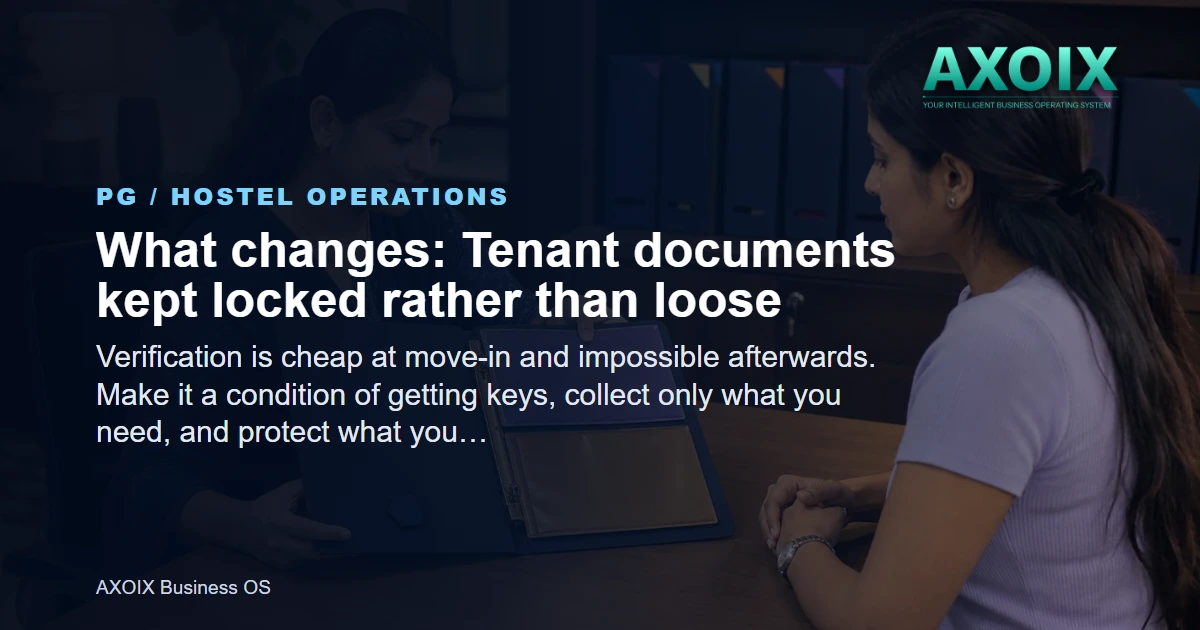
The instinct is to collect everything. Resist it — every document you hold is one you're responsible for protecting, and a PG office drawer full of identity documents is a genuine liability.
A defensible baseline:
Government photo ID, verified against the person in front of you. Sighting it matters more than storing it.
Permanent address, independently of the ID.
Employer or institution, with a contact — for a working professional or a student respectively.
Guardian or emergency contact, which is a safety necessity rather than a verification one.
Previous accommodation, which is the field most likely to reveal a problem and the one least often asked.
What to think twice about: retaining photocopies indefinitely, collecting documents you have no use for, and photographing IDs on a personal phone — which is startlingly common and is the weakest link in most PGs.
Holding it responsibly
Three practices, in order of how much they reduce your exposure:
Store identity data encrypted rather than as readable records. Tenant government IDs are stored encrypted in AXOIX — see the safety and compliance post.
Limit who can see it. A warden needs to verify at move-in. They rarely need to retrieve a former tenant's ID.
Decide a retention period and actually apply it. Indefinite retention is a decision made by not deciding.
India's data protection framework has been evolving, and obligations around personal data apply to PG operators like any other business. This is worth a conversation with a professional rather than an assumption that small businesses are out of scope.
The practical failure mode
Not refusal — delay. A tenant moves in on a Sunday, verification is "tomorrow," and tomorrow doesn't happen because the room is occupied and rent is being paid and nothing is going wrong. Six months later there's an incident and the record doesn't exist.
The fix is procedural rather than technological: verification happens at move-in or the tenant doesn't get keys. Once you've made an exception for one person you've made it for everyone, because your staff learn that the rule is negotiable.
A practical operating workflow for this PG
The useful way to apply Tenant Verification: The Step Every PG Skips Until Something Happens is to turn the idea into a repeatable operating rhythm. Start with the current process, not the software screen. Write down who begins the task, what information they need, where the record is kept, who checks an exception, and what the resident is told. That prevents a common PG mistake: digitising an unclear process and discovering that the same argument now happens faster.
Step 1 — establish the starting record. Many jurisdictions expect landlords and PG operators to verify tenants , with police involvement in some. The owner or warden should decide which field, document or confirmation is the source of truth. Existing residents, rooms, balances or requests should be checked before a new workflow is switched on. If the starting record is incomplete, note the gap openly instead of filling it with an assumption.
Step 2 — define responsibility. The requirement, format and route are local — confirm for your city rather than following a general article. Name the person who enters the record, the person who can approve a change, and the person who follows up when something is overdue. In a small PG those roles may belong to one person, but writing them down still matters. It stops a cook, caretaker, accountant and owner from each believing that somebody else handled the same exception.
Step 3 — test one real case end to end. Collecting ID creates a data protection responsibility. More collection is not more diligence. Use one room, one resident or one billing cycle first. Follow the record from the first action to the final acknowledgement. Check the owner view, staff view and resident-facing result separately. A backend record or internal screen is not enough if the person expected to act cannot reach it.
Step 4 — keep an exception path. Decide what happens when information is late, a resident disputes the record, a staff member lacks permission, or the usual approver is absent. Record the reason for any manual correction. Do not quietly overwrite history simply to make a dashboard look tidy.
What the weekly review should cover
Fifteen focused minutes is enough when the team brings the same evidence each week. Review what was completed, what remains open, which cases needed manual intervention, and whether residents received the message or document they were meant to receive. The objective is not a perfect-looking count. It is to find repeated friction while it is still small enough to fix.
Review question Evidence to check Action if it fails
Did the process start with a complete record? The original entry, document or resident confirmation Correct the source and note who verified it
Did the right person act? User, timestamp and permission trail where available Clarify responsibility or access before the next cycle
Did the resident receive a clear outcome? Receipt, message, portal view or signed acknowledgement Send the missing confirmation and repair the template
Did an exception repeat? Open cases and manual corrections from the week Change the process; do not keep relying on memory
For What verification is actually for, ask whether staff explain the process consistently. For What to collect, and what not to, compare the operating record with what the resident experienced. For Holding it responsibly, look for cases handled outside the agreed path. These checks do not assume an automated report, alert or capability that the article has not established.
A safe rollout checklist
Confirm the property, room and resident scope before changing any record.
Check that only the intended role can create, approve, reverse or view the relevant information.
Run a real test with the people who perform the work, not only an administrator.
Keep the previous record available until the new result has been checked.
Tell residents what changes, what does not, and where they can raise a dispute.
Review the first week and document every manual workaround.
This checklist protects both sides. Residents get a process they can understand and question. Owners get a record that can be checked later instead of an argument reconstructed from memory. It also respects the boundary between guidance and capability: use only screens, permissions and resident surfaces actually reachable in your Hotel/Hospitality tenant.
One more question operators ask
Should we move every existing case into the new process at once?
No. Start with a controlled group or the next clean cycle, reconcile the result, and then expand. A staged rollout is slower for a few days and far safer than correcting every resident record after a rushed migration.
Where we're honest about the limits of this post
No specific requirement, form, portal or timeline is stated here, because these are set locally and have changed. Whether police verification is mandatory for your property, what form it takes, and who submits it are questions with local answers. Ask your local police station, and confirm with a lawyer if the answer is unclear. Nothing here is legal advice.
FAQ
Is verification the landlord's job or the tenant's?
Typically the property owner or operator initiates it. Confirm locally — this specific point varies.
Can I refuse a tenant who won't provide ID?
Yes, and you should. A prospective tenant unwilling to identify themselves is telling you something.
What about tenants who are students?
Institution details plus guardian contact matter more here, and guardians frequently expect to be recorded.
The bottom line
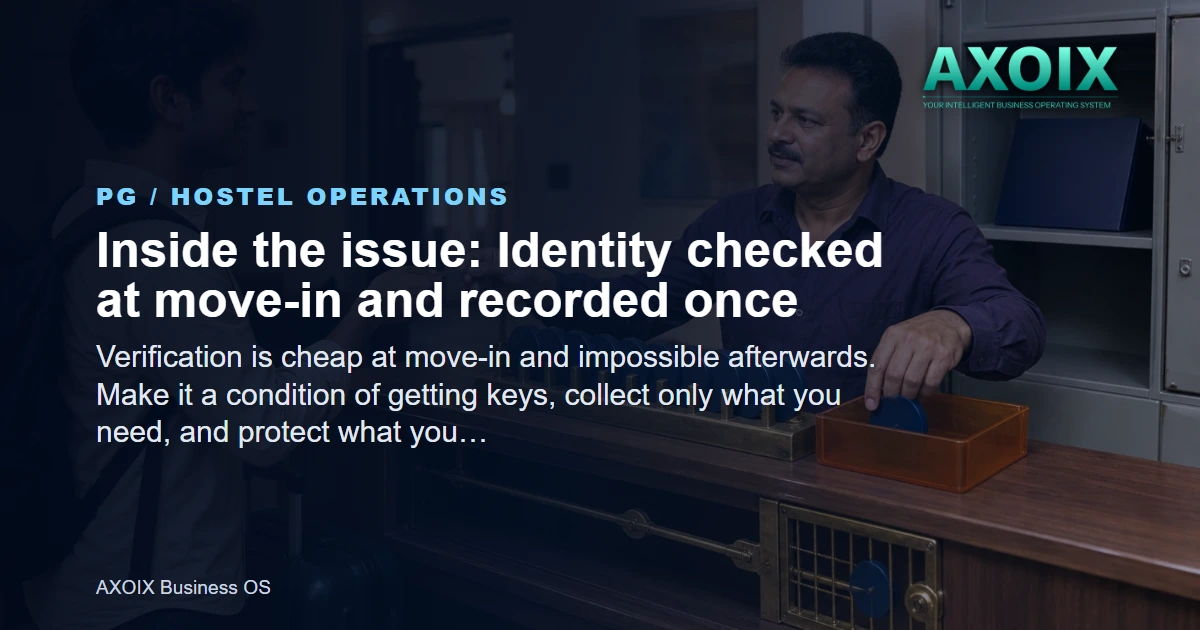
Verification is cheap at move-in and impossible afterwards. Make it a condition of getting keys, collect only what you need, and protect what you collect.
See how safety and compliance fit together, document uploads, or pricing.
Verify at move-in, every time. Start free →
Comments